
Quick answer: A good boutique discount strategy starts with one formula: units needed = margin / (margin – discount). At a 60% margin, 20% off means you must sell 1.5 times the units just to earn the same gross profit. So discount slow sizes and late-season stock, use bundles and thresholds for traffic events, and keep best sellers at full price.
A boutique discount strategy is a written plan for when, how deep and on which items a kids boutique lowers its prices. A boutique discount strategy is set before the season, so markdowns follow rules instead of panic in the last weeks.
Black Friday, end-of-season sales and “flash” codes are tempting because they bring a quick spike in orders. But a kids boutique with small volumes can easily discount itself into a loss. This boutique discount strategy shows how to decide how deep to go, which pieces to discount, and which offers bring sales without cutting your margin in half.
Key takeaways
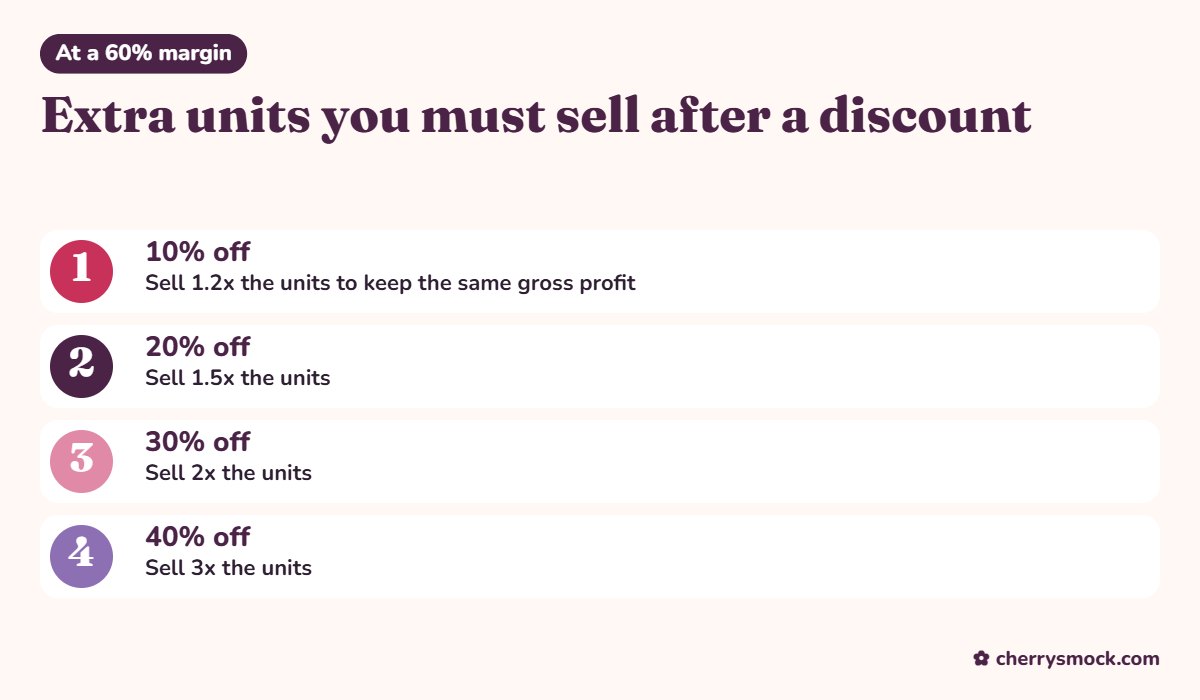
- Units needed after a discount = margin / (margin – discount). At 60% margin: 20% off needs 1.5x units, 30% off needs 2x.
- Discount by reason: slow sizes, end of season, damaged or last pieces. Never the best seller in its peak weeks.
- For traffic events like Black Friday, prefer thresholds and bundles over a flat sitewide cut.
- Plan a markdown ladder before the season starts so decisions are not emotional.
- Buy smaller and re-order faster to need fewer discounts in the first place.
The one formula every boutique discount strategy needs
Gross profit per piece falls much faster than the price. If a dress costs you $14 landed and sells for $35, you keep $21 (60%). At 20% off it sells for $28 and you keep $14. You now need 21 / 14 = 1.5 times the units to make the same money.
Write it as: units needed = margin / (margin – discount), using percentages of the original price.
If you are not sure what your real margin is, start with landed cost: our landed cost guide explains it, and the free planner calculates it per style.
What should a kids boutique discount (and never discount)?
| Discount | Why |
|---|---|
| Slow sizes of a style that otherwise sold | Frees cash without hurting the hero size run |
| Seasonal prints after the holiday | Value drops sharply after the date passes |
| Last 1-2 pieces of a style | Makes room for new arrivals |
| Do not discount: best sellers in peak weeks | You give margin to people who would buy anyway |
| Do not discount: brand-new arrivals | Trains customers to wait for sales |
What markdown ladder should a boutique discount strategy use?
Decide in advance when each step happens, then follow it. A typical 12-week season ladder is shown below; adjust weeks to your season length.
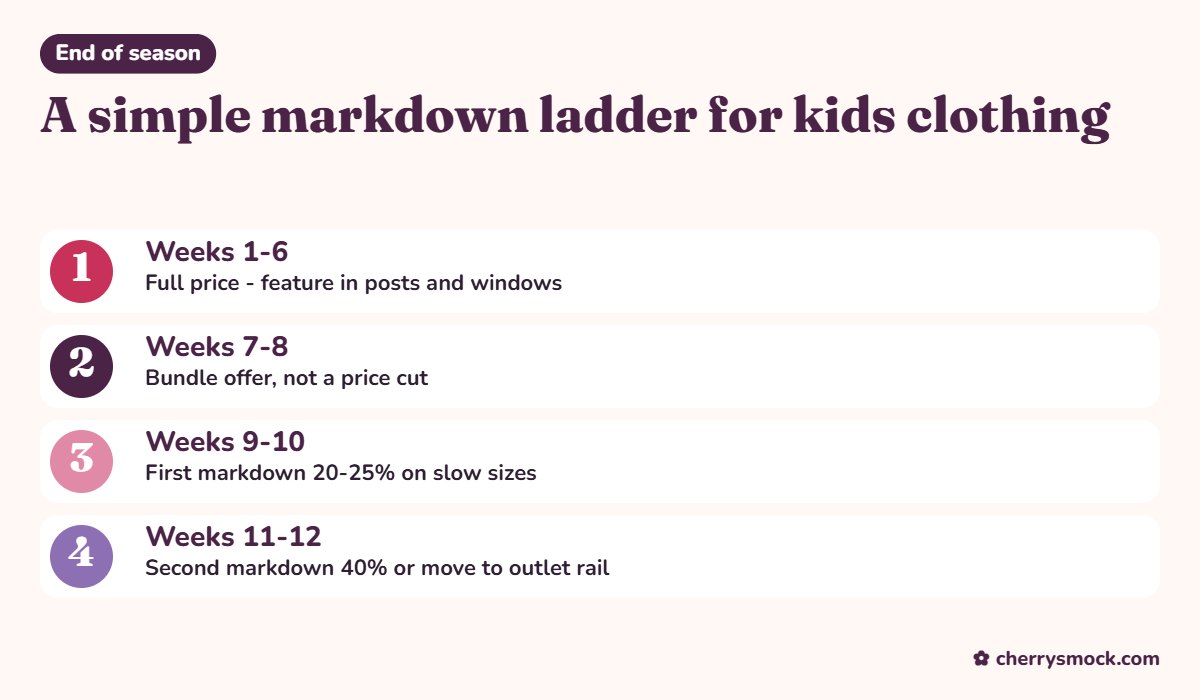
Use sell-through to decide: if a style has sold less than about half its units by mid-season, it goes on the ladder. Read days of cover and reorder point to spot slow stock early.
Which Black Friday offers fit a boutique discount strategy?
Pair these with the levers in our boutique average order value guide, so each order is bigger rather than cheaper.
- Threshold gift: “Spend $75, get a free bow” instead of 25% off everything.
- Bundle price: party dress + daily set at one rounded price.
- Early access for your list, full price on new arrivals, discounts only on last season.
- A small, time-boxed discount on a defined group of styles, not sitewide.

How does buying smaller cut discounts in a boutique discount strategy?
Most discounting comes from over-buying. Ready-to-ship stock from 10 pieces per design (5-7 days to leave our workshop) lets you test a style small and re-order what sells. Group orders (from 30 pieces per design, about 20 days) suit styles already proven. See small batch ordering vs one big order.
Factory insight: Most deep discounts in kids boutiques come from buying too much of one style up front. Buying 10 pieces per design from ready-to-ship stock and reordering the winners in 5 to 7 days usually saves more margin than any clever markdown plan, because less stock is left to discount.
Boutique discount strategy: stock facts
| Fact | Detail |
|---|---|
| Ready-to-ship minimum | Ready-to-ship styles start from 10 pieces per design. |
| Ready-to-ship dispatch | In-stock styles ship in 5 to 7 days. |
| Group orders | A group order lets several boutiques share one hand-smocked design; it starts from 30 pieces per design and takes about 20 days. |
| Volume discount | Orders of 500 to 1,000 pieces get 2% off, 1,000 to 5,000 pieces get 5% off, and over 5,000 pieces get 7% off. |
| Payment terms | Orders under $1,000 are paid 100% upfront; orders of $1,000 to $5,000 use a 70% deposit and 30% before shipping; orders over $5,000 use 50% and 50%. |
| Transit time | Delivery after dispatch takes about 3 to 4 days to the US or Canada and 4 to 5 days to the UK or Europe. |
| Returns | Serious manufacturing defects can be reported within 7 days of delivery under the return policy; all other sales are final. |
Boutique discount strategy: when to discount and when not to
A boutique discount strategy sets rules in advance so discounts move stock without training customers to wait for sales.
| Situation | Better tool than a sitewide discount |
|---|---|
| Slow seller after 6 weeks | Style-specific markdown |
| Raising order value | Bundle or gift with purchase |
| Rewarding loyal customers | Early access or loyalty credit |
| Holiday peak | No discount; push gift services |
| End of season | Clearance on remaining stock only |
Limits to set
- No more than a few sitewide events a year.
- Maximum discount depth based on gross margin.
- Never discount new arrivals in the first weeks.
Review your boutique discount strategy against gross margin each month.
Boutique discount strategy: key points
- A boutique discount strategy sets rules before the season.
- Bundles beat sitewide sales in a boutique discount strategy.
- Protect new arrivals in your boutique discount strategy.
- Base depth limits in your boutique discount strategy on margin.
- Review the boutique discount strategy monthly.
Boutique discount strategy: FAQ
How much should a boutique discount on Black Friday?
Keep any direct discount limited to selected styles and check the formula first: at a 60% margin, 20% off already needs 1.5x the units. Thresholds and bundles usually work better.
When should I start end-of-season markdowns?
When a style has sold less than about half its units by mid-season, start a planned ladder: bundle first, then 20-25%, then about 40%.
Is a sitewide discount ever a good idea?
Rarely for small boutiques. It gives margin away on items that would sell at full price.
How do I avoid customers waiting for sales?
Keep new arrivals and best sellers at full price, and make discounts specific and time-boxed.
How can I plan discounts in advance?
Use the free Cherrysmock planner to set prices from landed cost and track stock by days of cover.
Free gift: the Cherrysmock Boutique Planner – landed-cost and pricing formula, days-of-cover stock tracker, season order calendar and 11 short lessons. Get the free planner
Want stock, prices or an order plan for your store? Talk to Jessi and the Cherrysmock team or message us on WhatsApp – we reply within one business day.
Know a boutique owner who needs this? Share it: WhatsApp | Facebook | Email
Found this useful? Send it to a boutique owner who would use it too.
Keep reading
More guides for boutique owners, picked for you.


Ready-to-ship styles for your boutique
Low MOQ from 10 pcs per style. Ready to ship in 5-7 days.



Tell us your budget and customers. We reply within one business day.
WhatsApp usHow to order