Quick answer: A smocked clothing quality check covers 7 points: fabric weight, smocking stretch and evenness, construction, size and fit, a wash test, safety and labelling for your market, and an arrival check of a few pieces from every carton. Most quality problems in smocked clothing show up in one...
Read more
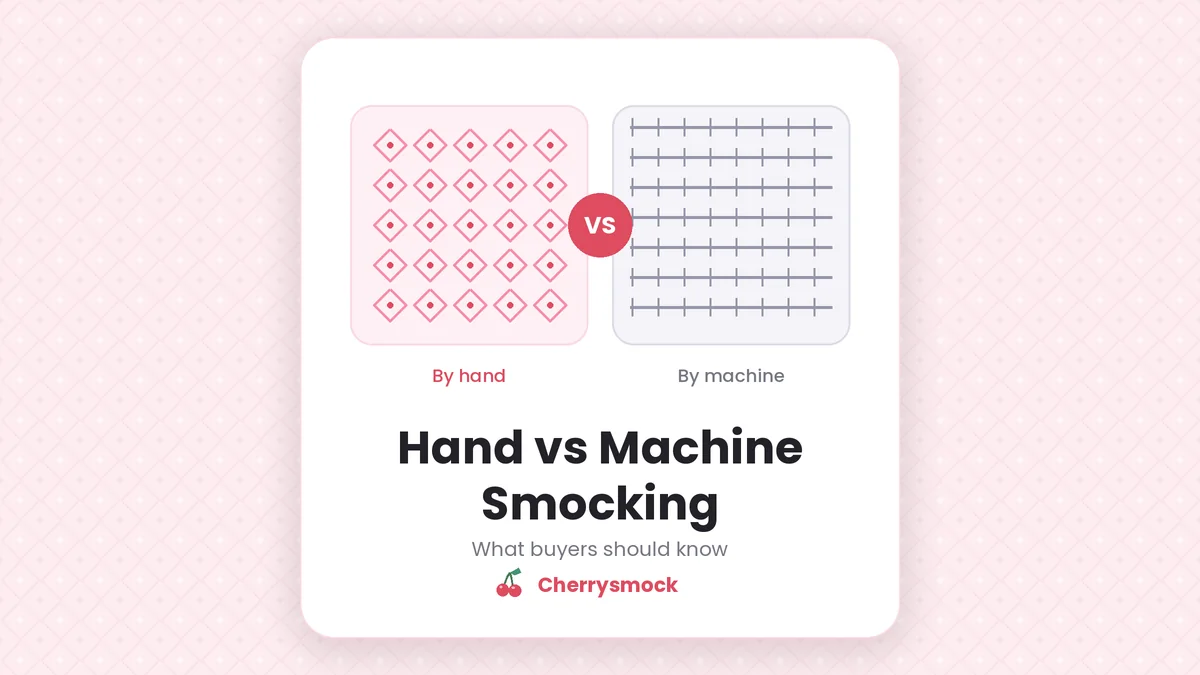
Hand smocking vs machine smocking: how to tell them apart, what each costs, and which to choose for a boutique range.
Read more
Quick answer: A French knot stitch is a small raised embroidery knot made by wrapping thread around the needle one to three times and stitching back through the fabric next to the starting point. It is used for flower centres, eyes, dots and texture, and it often decorates the smocked...
Read more
Quick answer: Smocked dress production at Cherrysmock follows these steps: select the fabric, cut the pieces, pleat the panel, hand smock and embroider it, sew the dress, finish and press it, then check quality and pack. Group orders take about 20 days and custom designs about 30 to 35 days...
Read more
Quick answer: The history of smocking runs from practical work smocks worn by English farm labourers in the 18th and 19th centuries to the decorative hand smocking on children’s dresses today. The word comes from “smock”, a loose working shirt, and the pleats once gave room to move while keeping...
Read more
Quick answer: The best fabric for a smocked dress is a lightweight, tightly woven cotton, such as broadcloth, gingham or batiste, because it pleats evenly and holds hand smocking well. Polyester blends, linen, silk and velvet can also work, but each changes the drape, care and price of the dress....
Read more
Quick answer: How to care for smocked clothing: wash it cold on a gentle cycle or by hand inside out, treat stains quickly, dry it flat or line dry away from direct heat, iron the fabric around the smocking but not the pleats, and store it clean and folded in...
Read more
Quick answer: Smocked clothing is clothing in which a panel of fabric is gathered into small, even pleats and held in place with decorative embroidery stitches, so the panel stretches. It is used mostly on children’s dresses, rompers and bubbles, and hand-smocked pieces are often kept as heirlooms. Smocked clothing...
Read more