

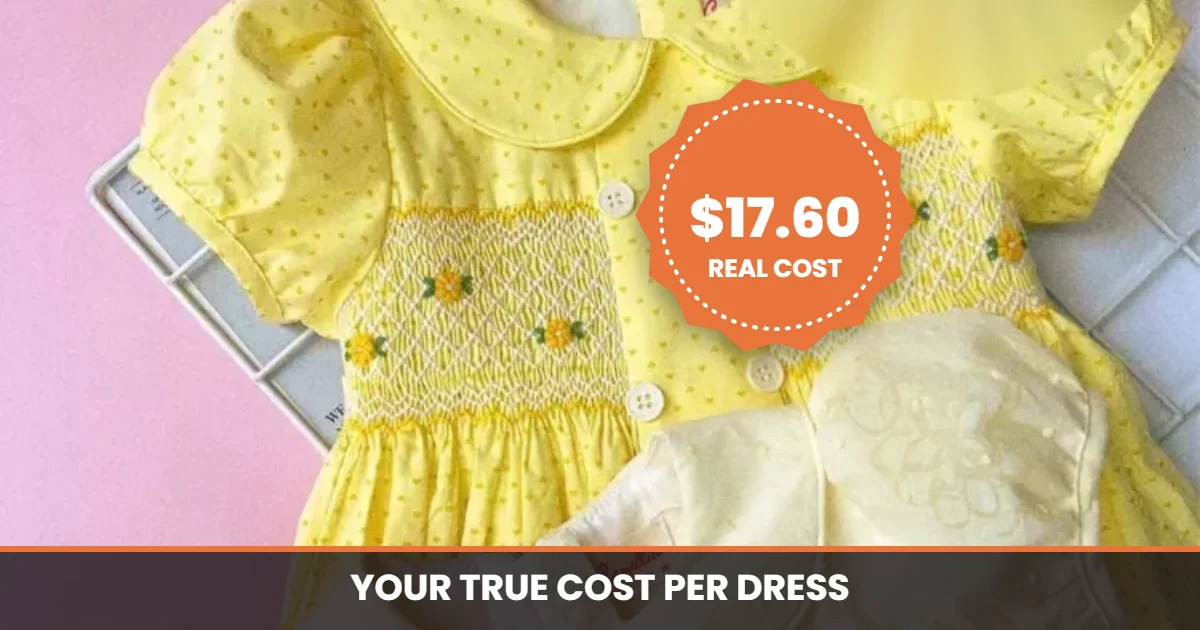
Landed cost is the total cost of one piece by the time it is ready to sell in your shop. It includes the factory price, but also freight, duty and the small items people forget. If you price from the factory price alone, you will think you earn more than you do.
By the Cherrysmock team, Hanoi, Vietnam. Updated October 2026.
Quick answer: Landed cost is the full per-piece cost of a product once it reaches your shelf: factory price + shipping per piece + duty + packaging. Example: $12.00 + $5.00 + $0.60 = $17.60. Price from this number, not from the factory price, or your real margin will be lower than you think.
Key takeaways: landed cost
- Landed cost = factory price + shipping + duty + packaging, per piece.
- Example: a $12 dress becomes a $17.60 dress once it reaches your shelf.
- Pricing at 2x landed cost gives about a 50% gross margin before fees.
- Order size changes landed cost: small orders have higher freight per piece but less cash at risk.
What is included in landed cost?
- Factory price per piece.
- International shipping, divided by the number of pieces. Air freight is fast but is charged by weight, so heavier items cost more per piece.
- Import duty and taxes in your country. Rates depend on the product and the market, so check yours.
- Packaging: bags, tags, boxes.
- Allowance for damage and returns, because some pieces never earn a full sale.
Platform and payment fees are not part of landed cost, but they come off your price, so count them when you check your margin.
The formula
Landed cost per piece = factory price + shipping per piece + duty per piece + packaging per piece
Worked example
- Factory price: $12.00
- Shipping and duty: $5.00
- Packaging: $0.60
- Landed cost: $17.60
Price at 2x landed cost and you charge $35.20. A 3% payment fee takes about $1.06, so you keep $16.54, a margin of about 47%. Price it at $30 because the factory price “looked cheap”, and your profit drops to about $11.50 per piece. That is a third less, on every sale.
Why order size changes landed cost
Freight per piece usually falls when you ship more at once, so big orders look cheaper per piece. But a big order also locks more cash and leaves more unsold stock. Compare both before you decide. We show the numbers in one big order versus three small orders.

Three steps to use it every time
- Ask your supplier for the weight of each piece, so you can estimate freight per piece before you order.
- Write the landed cost in a sheet, one row per design.
- Price from the landed cost, not the factory price. Then read how to price smocked dresses to set your margin.
If you want to see how a supplier’s terms change your cost, read how to order wholesale smocked clothing from Cherrysmock. Samples have no minimum, smocked designs start at 30 pieces per design, and ready-to-ship Princess Dress and Daily Dress start at 10 pieces per design.
Cost versus gross margin
Once you know this number, you can check your gross margin: (selling price minus cost) divided by selling price. At $35.20 and a cost of $17.60, gross margin is exactly 50%. If you forgot freight and priced from $12, you would believe the margin was 66%, and you would discount too far.
A checklist for each new design
- Factory price per piece, confirmed in writing.
- Weight and packed size per piece, so freight can be estimated.
- Duty and tax rate for your country and product type. Ask your customs broker if you are unsure.
- Packaging you add yourself: polybags, tags, boxes.
- An allowance for damaged or returned pieces.
Keep this in one row per design. When freight rates or duty change, update the row and your price, not just your hope.
Conclusion
Knowing this number is the first step to a profitable boutique. Write it down for every design, price from it, and re-check it whenever freight or duty changes.
Frequently asked questions about landed cost
What is the difference between landed cost and factory price?
The factory price is only what the supplier charges for the piece. Landed cost adds shipping, duty and packaging, so it is what the piece really costs you when it reaches your shelf.
How do I estimate shipping per piece before I order?
Ask the supplier for the weight of each piece and the packed size, then ask your carrier or forwarder for a rate. Divide the total freight by the number of pieces in the shipment.
Should I include platform fees in landed cost?
Usually not. Keep landed cost for the product, then subtract platform and payment fees from the selling price when you check your margin.
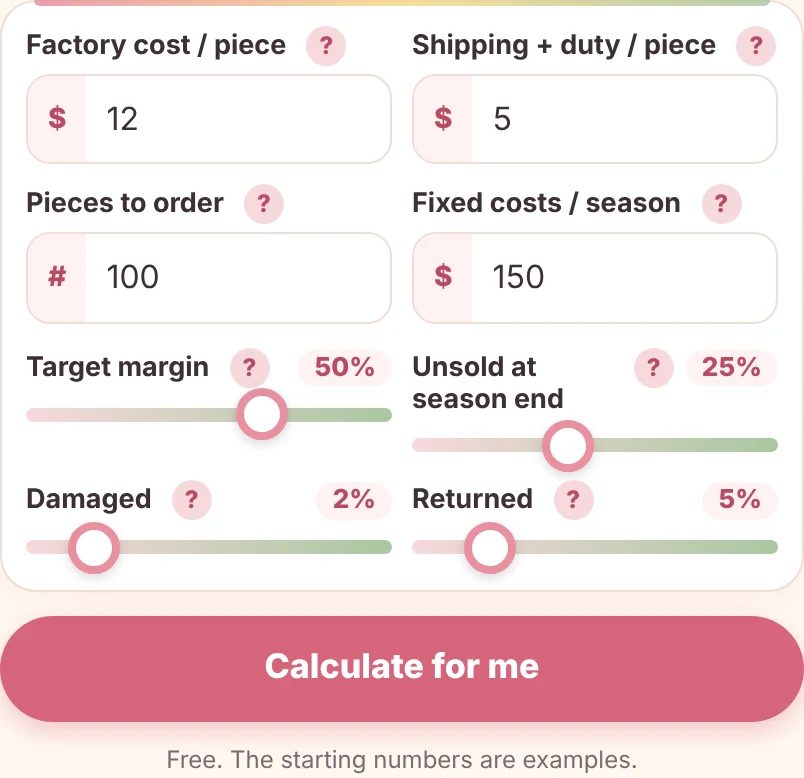
Calculate your landed cost in 2 minutes, free
Type in factory price, freight, duty and fees. The planner returns your true cost per dress and a suggested retail price. Open it, then add it to your phone home screen. Your numbers stay on your own device.
Keep reading
More guides for boutique owners, picked for you.


Ready-to-ship styles for your boutique
Low MOQ from 10 pcs per style. Ready to ship in 5-7 days.



Tell us your budget and customers. We reply within one business day.
WhatsApp usHow to order