
Break even for a seasonal collection is the number of pieces you must sell to get back what you spent on the lot and the costs around it. Because seasonal stock loses value after the event, the question is not only how many pieces you need to sell, but how many you need to sell at full price.
Last updated: October 28, 2026. Written by the Cherrysmock team from real wholesale orders of hand-smocked kids clothing made in Hanoi, Vietnam.
Quick answer: Break even pieces = (cost of the lot + fixed costs) / (price – selling cost per piece). With a $810 lot of 30 pieces, $300 of fixed costs, a $60 price and $3 of selling cost per piece, you need about 20 pieces sold at full price to break even.
Buying wholesale for your boutique?
Cherrysmock is a hand-smocked children's clothing manufacturer in Hanoi. Browse wholesale smocked clothing, princess dresses wholesale (ready to ship), seasonal smocked collections or design your own smocked clothing. MOQ from 10 pcs per style.
Get the price list on WhatsAppThis article explains the formula, then shows what happens when some pieces are marked down. See break-even analysis for the general idea.

The inputs
| Input | Example |
|---|---|
| Pieces in the lot | 30 |
| Landed cost per piece | $27 |
| Cost of the lot | 30 x $27 = $810 |
| Fixed costs for the season (photos, ads, packaging set-up) | $300 |
| Selling price | $60 |
| Selling cost per piece (payment fee and packing) | $3 |
The calculation
- Total outlay = $810 + $300 = $1,110.
- Net per piece at full price = $60 – $3 = $57.
- Break even pieces = $1,110 / $57 = 19.5, so 20 pieces.
- Break even as a share of the lot = 20 / 30 = 67 percent.
That means you need to sell two out of every three pieces at full price to recover your money. If you can only count on selling half, the lot loses money unless you raise the price or reduce the cost.
What markdowns do to the answer
| Scenario | Sold at $60 | Sold at $36 | Unsold | Net revenue | Profit |
|---|---|---|---|---|---|
| A | 20 | 10 | 0 | $1,470 | $360 |
| B | 24 | 6 | 0 | $1,566 | $456 |
| C | 15 | 5 | 10 | $1,020 | -$90 |
In scenario C, you have not lost the 10 unsold pieces; they are still stock worth $270 at cost. The question is whether you can sell them next season without further cost. For markdown depth, see our markdown calendar.
Use the planner for a quick check
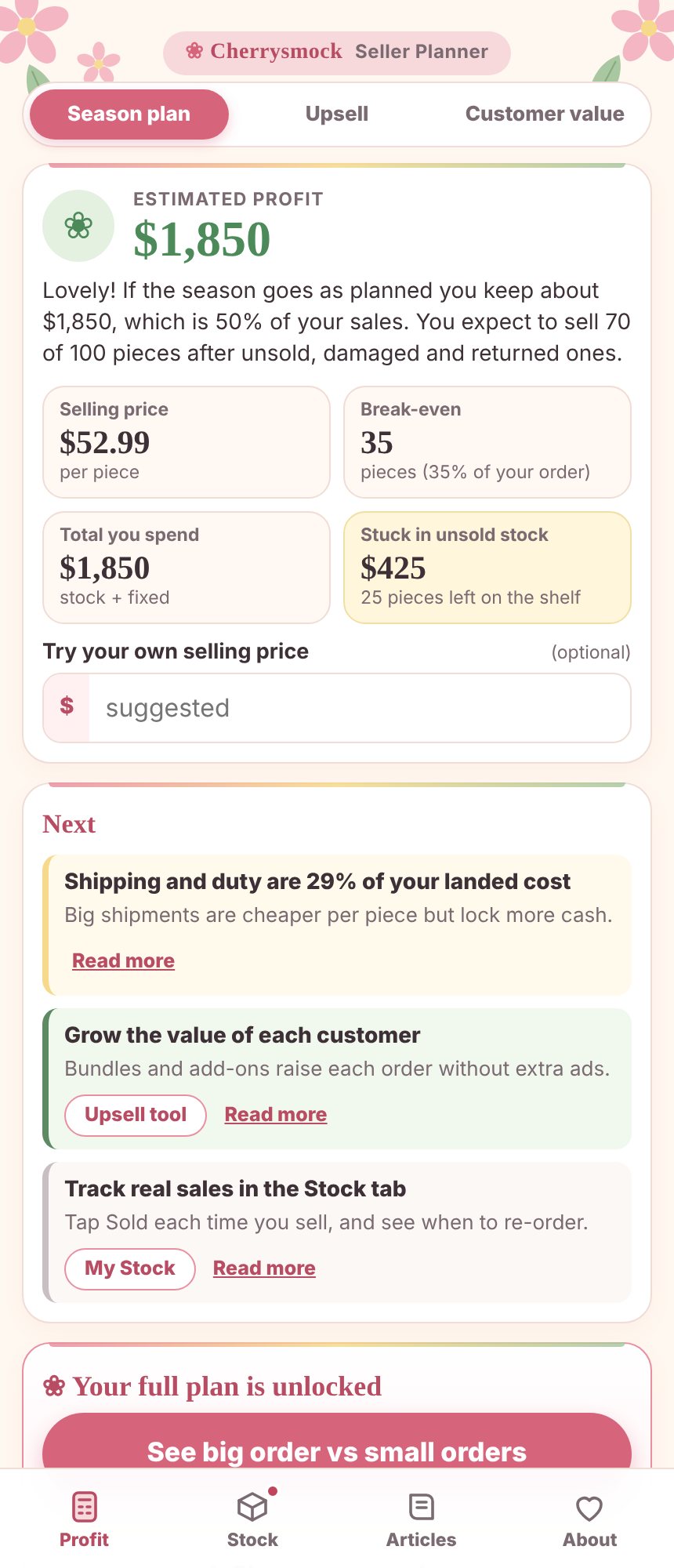
The Cherrysmock Planner calculates break even in pieces and as a share of your order, including unsold, damaged and returned percentages. In the sample above, break even is 35 pieces of a 100-piece order, and 25 pieces remain on the shelf. Change the numbers to see how margin, unsold stock and returns change the result.
Ways to lower your break even
- Lower the cost: a better freight plan or a larger lot may reduce cost per piece; see our guide to freight per piece.
- Raise the price on premium designs; see the price ladder.
- Reduce fixed costs: use your own photos and organic social.
- Pre-sell part of the lot before it arrives. A pre-order lowers risk; see the pre-order model.
Break even for a ready-to-ship lot
A ready-to-ship lot of 10 pieces has a lower outlay and a shorter wait (5 to 7 days), so break even is reached faster. For an example landed cost of $13 and a price of $30: 10 x $13 = $130, plus $50 fixed costs gives $180, divided by $27 net per piece (after a $3 selling cost) gives 6.7, so 7 pieces. Ready-to-ship is available for princess dresses and daily sets only; hand-smocked pieces are made to order.
Mistakes to avoid
- Ignoring selling cost per piece.
- Assuming all pieces sell at full price.
- Counting unsold stock as zero value or full value; use your best estimate of the next-season price.
A quick break even table for three prices
| Price | Net per piece | Break even pieces for a $1,110 outlay | Share of a 30-piece lot |
|---|---|---|---|
| $54 | $51 | 22 | 73% |
| $60 | $57 | 20 | 67% |
| $66 | $63 | 18 | 60% |
A $6 increase in price lowers break even by two pieces. If customers still buy at the higher price, the lot is safer, and you can see why a price test on one design is worth the effort.
FAQ
What is break even for a seasonal collection?
The number of pieces you must sell to cover the cost of the lot and fixed costs. Because seasonal stock is marked down after the event, count how many you must sell at full price.
How do I calculate break even pieces?
Divide total outlay (lot cost plus fixed costs) by net revenue per piece (price minus selling cost).
What if I mark down some pieces?
Add the net revenue from marked-down pieces to the full-price revenue and compare with total outlay.
Does the planner calculate break even?
Yes. The free Cherrysmock Planner shows break even in pieces, profit and unsold stock for the numbers you enter.
Plan the lot before you order
Tell us the design and the season, and we will quote the 30-piece lot so you can enter real costs into the planner.
Message Cherrysmock on WhatsApp with the styles you are considering, or run your numbers first in the free Cherrysmock Planner, which calculates cost price, selling price, stock and cash for your shop.
Found this useful? Send it to a boutique owner who would use it too.
Keep reading
More guides for boutique owners, picked for you.


Ready-to-ship styles for your boutique
Low MOQ from 10 pcs per style. Ready to ship in 5-7 days.



Tell us your budget and customers. We reply within one business day.
WhatsApp usHow to order