
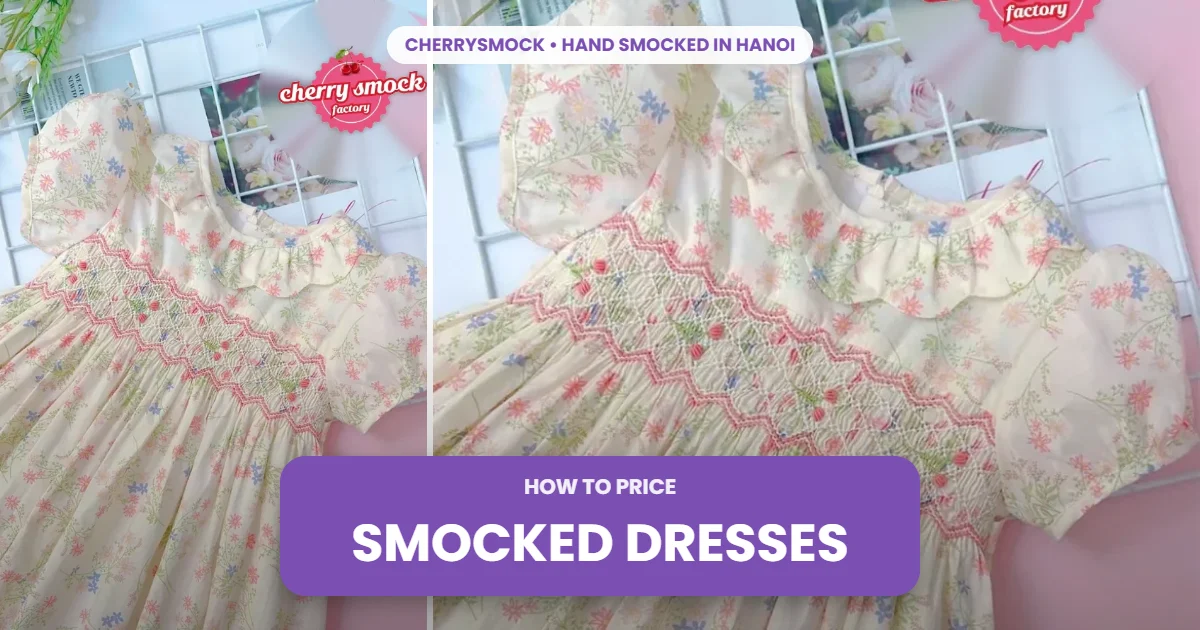
Pricing is where most small boutiques win or lose their season. This guide explains how to price smocked dresses from your landed cost, why markup and margin are different, and how much discount you can afford before your profit disappears.
By the Cherrysmock team, Hanoi, Vietnam. Updated October 2026.
Quick answer: To price smocked dresses, start from landed cost, then multiply: 2x gives a 50% margin, 2.5x gives 60% and 3x gives about 67%. Hand smocked pieces take far more labour than machine-made ones, so most boutiques aim for 2.5x or more. Decide your lowest acceptable margin before any sale.
How to price smocked dresses is the method of turning landed cost into a retail price that covers labour-heavy hand work and still leaves margin. Knowing how to price smocked dresses is a margin decision, made before the season, not at the till.
This guide covers how to price smocked dresses step by step, with example numbers you can reuse.
Key takeaways: how to price smocked dresses
- Markup and margin are different: a 100% markup is a 50% margin.
- Landed cost $17.60 priced at 2x, 2.5x and 3x gives $35.20, $44.00 and $52.80.
- A higher starting price buys you room for sales: 20% off 2.5x still leaves a 50% margin.
- Show close-ups of the hand smocking to support a higher price.
How do markup and margin change how to price smocked dresses?
- Markup is how much you add on top of your cost. A 100% markup doubles the cost.
- Margin is the share of the selling price that you keep as profit. A 100% markup gives a 50% margin.
Mixing them up is common and costly. A “50% markup” sounds healthy, but it is only a 33% margin.
What price ladder shows how to price smocked dresses?
Start with your landed cost. Using an example of $17.60:
| Multiplier | Selling price | Profit per piece | Margin |
|---|---|---|---|
| 2.0x | $35.20 | $17.60 | 50% |
| 2.5x | $44.00 | $26.40 | 60% |
| 3.0x | $52.80 | $35.20 | 67% |
Many independent retailers use about 2x as a starting point (often called keystone pricing). Hand smocked pieces take far more labour than machine-made clothes, so a higher multiplier is easy to defend. Read why in hand smocking versus machine smocking and why baby clothes are so expensive.
How do you set a discount budget when you price smocked dresses?
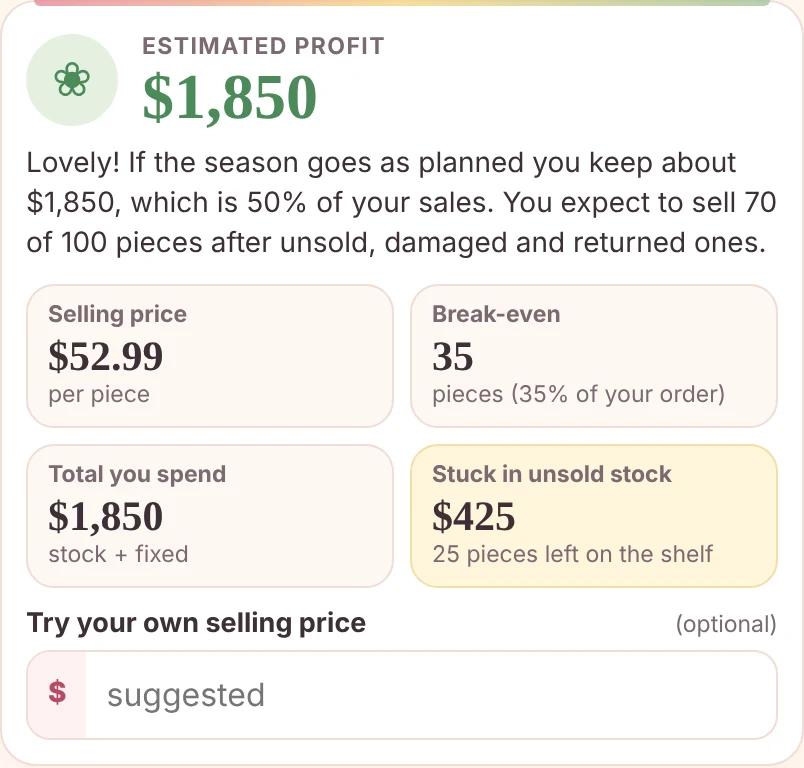
Decide your lowest acceptable margin first, then work out the discount. Example: you sell at $44.00 with a landed cost of $17.60. A 20% sale gives a price of $35.20 and a profit of $17.60, a 50% margin. That is still healthy. If you had priced at $35.20 to begin with, the same 20% sale would leave $10.56 profit, only 37.5%.
The lesson: a higher starting price buys you room to run a sale. Without that room, discounts turn into losses. See also why a boutique can sell a lot and still lose money.
Check your price against real life
Prices should also cover unsold stock, returns and fixed costs. In the free planner, enter your costs and target margin, and it shows a suggested selling price that already includes those risks, plus your break-even point.
Want to see our product range before you set prices? Browse the girls dresses collection. Smocked designs start at 30 pieces per design with about 20 days of production, and ready-to-ship Princess Dress and Daily Dress start at 10 pieces per design.
Three margin rules that keep you safe
- Price from landed cost, never from the factory price. See what landed cost is.
- Set a margin floor. Decide the lowest margin you accept (for example 40%) and never sell below that price.
- Keep sale depth within the floor. If 2x leaves you with 50% and your floor is 40%, you can only discount about 17% before you break your own rule.
Markup and margin: the formulas
markup is (price minus cost) divided by cost. gross margin is (price minus cost) divided by price. For a $17.60 cost sold at $35.20, markup is 100% and gross margin is 50%. Quote the one you mean, and compare suppliers and sales on the same basis.
Planning a sale? Remember that fees and returns come out of your price too. The planner’s suggested selling price includes unsold stock, damage and returns, so it is a safer starting point than a flat multiplier.
How to price smocked dresses: the short version
Knowing how to price smocked dresses comes down to three habits: cost every piece at landed cost, choose a margin floor, and keep discounts inside it. Do that, and hand smocking becomes the profitable part of your range.
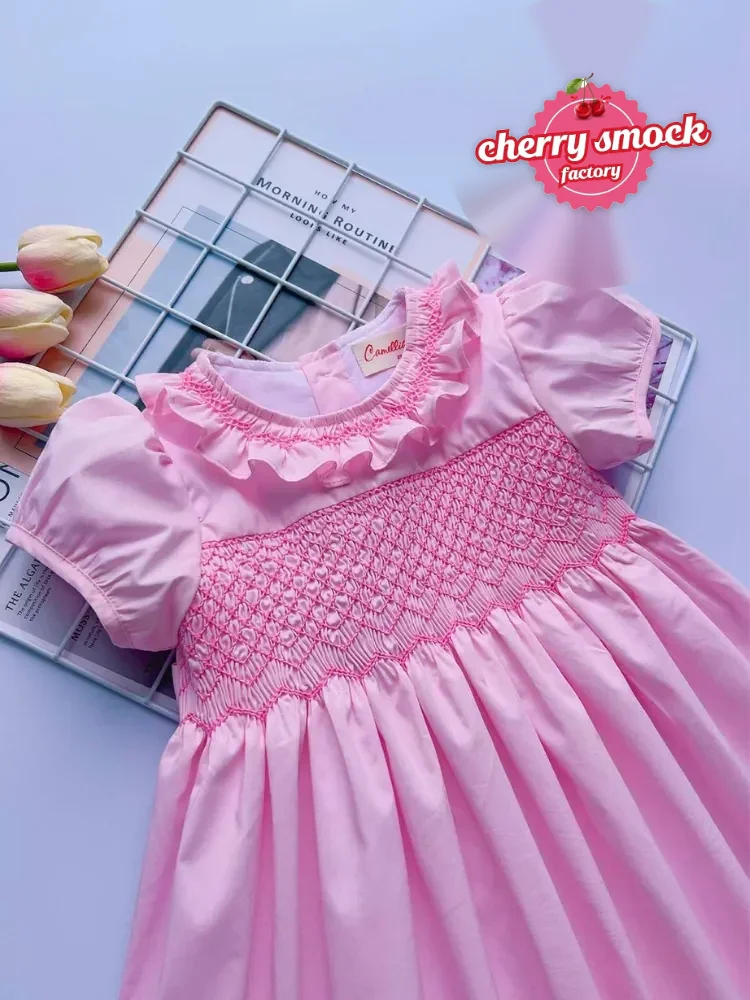
Factory insight: Hand smocking takes hours of hand work per panel, and parents who see the stitches up close accept a higher price. Show a close-up of the smocking on every product page and price card, because the photo does more to support a 2.5x price than any description.
How to price smocked dresses: supplier facts
| Fact | Detail |
|---|---|
| Hand smocking | Every smocked piece is hand smocked and hand embroidered by artisans in Vietnam. |
| Group orders | A group order lets several boutiques share one hand-smocked design; it starts from 30 pieces per design and takes about 20 days. |
| Ready-to-ship minimum | Ready-to-ship styles start from 10 pieces per design. |
| Payment terms | Orders under $1,000 are paid 100% upfront; orders of $1,000 to $5,000 use a 70% deposit and 30% before shipping; orders over $5,000 use 50% and 50%. |
| Volume discount | Orders of 500 to 1,000 pieces get 2% off, 1,000 to 5,000 pieces get 5% off, and over 5,000 pieces get 7% off. |
| Transit time | Delivery after dispatch takes about 3 to 4 days to the US or Canada and 4 to 5 days to the UK or Europe. |
| Packing | Each piece is ironed, folded and bagged; a five-layer 50 x 50 x 50 cm carton holds about 150 standard dresses or sets. |
Frequently asked questions about how to price smocked dresses
What is the difference between markup and margin?
Markup is the percentage added to your cost. Margin is the percentage of the selling price that is profit. A 100% markup equals a 50% margin.
Is it fair to price hand smocked dresses higher than machine-made ones?
Yes. Hand smocking takes much more skilled labour, so a higher price is easy to explain to customers. Show close-up photos of the stitching to support it.
How much can I discount a dress?
Decide your lowest acceptable margin first. If you price at 2.5x your landed cost, a 20% sale still leaves about a 50% margin. At 2x, the same sale leaves much less.
What multiple do boutiques use for hand-smocked dresses?
Many boutiques aim for 2.5x landed cost or more on hand-smocked pieces, which gives a gross margin of about 60 percent before fees.
Free gift: the Cherrysmock Boutique Planner – landed-cost and pricing formula, days-of-cover stock tracker, season order calendar and 11 short lessons. Get the free planner
Want stock, prices or an order plan for your store? Talk to Jessi and the Cherrysmock team or message us on WhatsApp – we reply within one business day.
Know a boutique owner who needs this? Share it: WhatsApp | Facebook | Email
Need help with how to price smocked dresses? Message us, or open the free planner below.
Test your markup before you set the price, free
See price, margin and break-even side by side, then check how much cash a first lot of 30 pieces would tie up. It works like an app, and your numbers stay on your own device.
Keep reading
More guides for boutique owners, picked for you.


Ready-to-ship styles for your boutique
Low MOQ from 10 pcs per style. Ready to ship in 5-7 days.


Tell us your budget and customers. We reply within one business day.
WhatsApp usHow to order