

A kids boutique losing money while orders keep coming is rarely a demand problem. It is a cost problem: shipping, unsold stock, returns, discounts and fixed costs that never made it into the price. This guide shows six of them with real arithmetic, so you can find your own gap.
By the Cherrysmock team, Hanoi, Vietnam. Updated October 2026.
Quick answer: A kids boutique usually loses money despite good sales because of costs nobody counted: shipping and duty, unsold stock, returns, discounts and fixed costs. In our example, a $1,550 paper profit became $564 after 25% went unsold and 5% was returned. The fix is to price from landed cost and order small lots.
This guide covers kids boutique losing money step by step, with example numbers you can reuse.
Key takeaways: kids boutique losing money
- Revenue is not profit: in the example, a $1,550 paper profit shrank to $564.
- Unsold stock is the biggest leak: 25 unsold dresses locked $425 of cash.
- A 20% discount cuts profit per piece by 40% and needs about 67% more sales to earn the same total.
- Small lots and fast re-orders shrink the biggest cost: stock that does not sell.
The paper profit versus the real profit
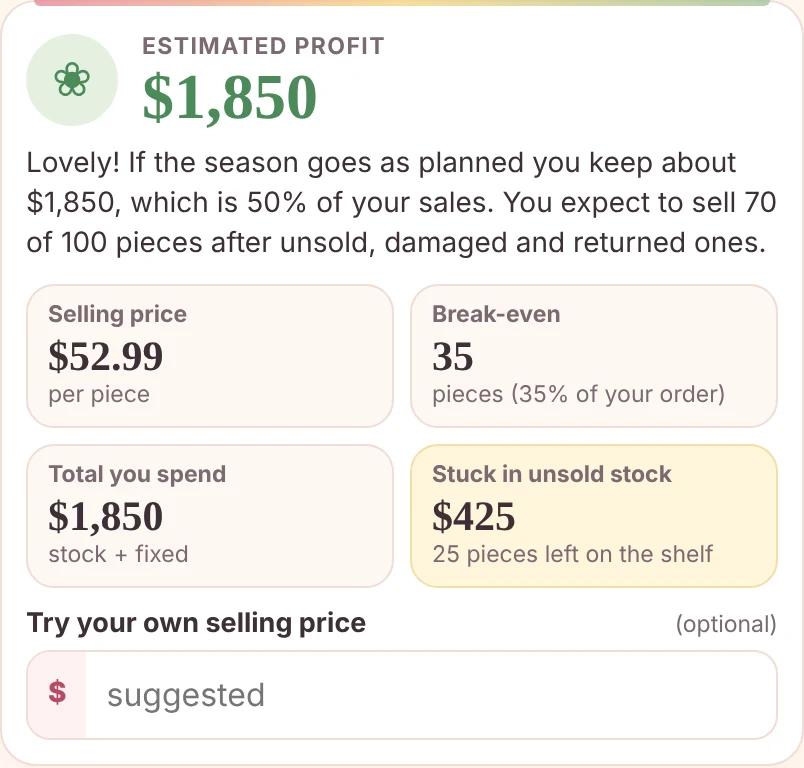
Take a simple example. You order 100 dresses. The factory price is $12, and shipping plus duty add $5 per piece, so your landed cost is $17 each ($1,700 in total). You add $150 of fixed costs for photos, packaging and listing, so you spend $1,850. You price each dress at $34, double your landed cost.
On paper: sell all 100 and you earn $3,400, a profit of $1,550. In real life, a season rarely goes that way. Say 25 pieces are still on the shelf at season end and 5% of what you sold comes back:
- 75 dresses sold: $2,550
- About 4 returns refunded: minus $136
- Revenue kept: $2,414
- Profit: $2,414 minus $1,850 = $564
That is only 36% of the paper profit, from a season that looked busy. The 25 unsold dresses also lock $425 of your cash on the shelf. (These are example numbers, not a promise. Your own numbers will differ.)
The 6 hidden costs
1. Shipping and duty are bigger than they look
In the example above, shipping and duty are $5 of a $17 landed cost, about 29%. Many new sellers price from the factory price and forget this part. Read our guide on what landed cost is to calculate it for every design.
2. Unsold stock
Every piece that does not sell is cost with no revenue. Seasonal products like smocked dresses are the most exposed, because a Christmas dress is hard to sell in January.
3. Returns and damage
A refund returns the sale, not your cost. Poor size guidance is the most common reason for returns, so put the size chart next to the buy button.
4. Discounts that need far more sales
At $34 with a $17 landed cost, you earn $17 per dress. Give 20% off and the price becomes $27.20, so you earn only $10.20. That is 40% less profit per piece, and you must sell about 67% more units just to earn the same total.
5. Fixed costs spread over too few sales
$150 of fixed costs sounds small. Spread over 75 sold dresses, it adds $2 to every piece. Sell fewer, and the number grows.
6. Cash stuck in the wrong stock
Money tied in slow designs cannot buy your next best seller. This is why how you buy matters as much as how you sell.
How to fix it: small lots and fast re-orders
You cannot remove every cost, but you can shrink the biggest one: unsold stock. That is why we built our terms around small risk:
- Samples with no minimum, so you check quality before you commit.
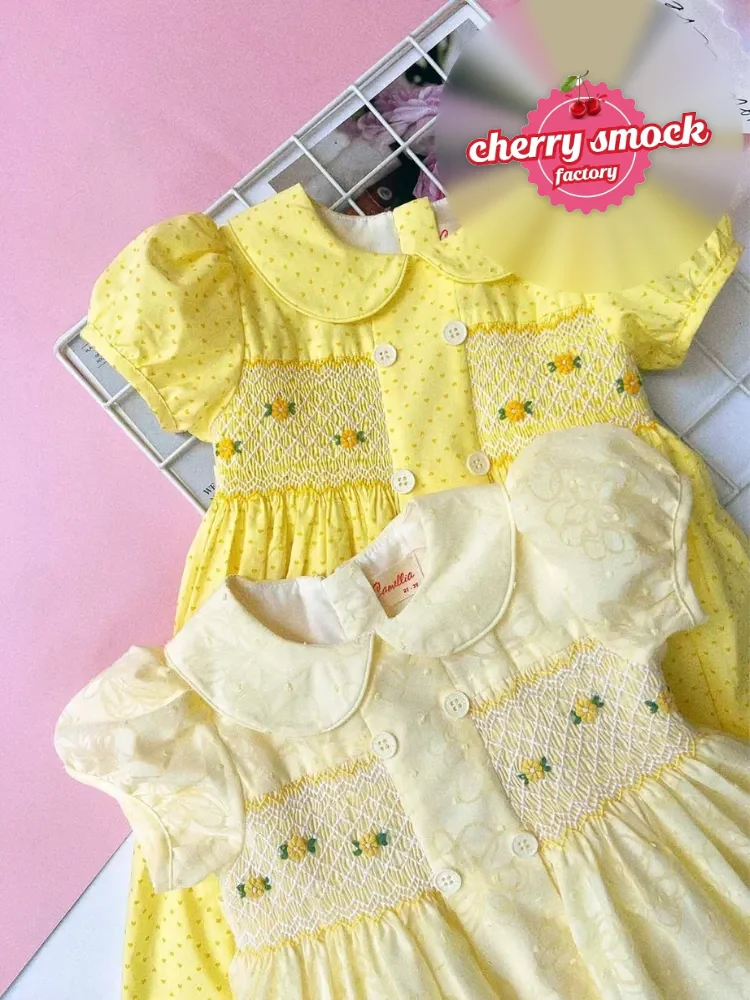
- Smocked designs from 30 pieces per design, made to order from our design pool in about 20 days.
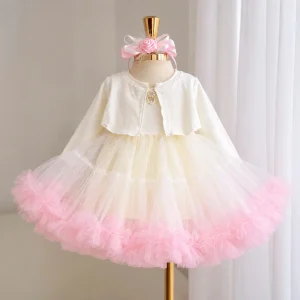
- Ready-to-ship Princess Dress and Daily Dress from 10 pieces per design, shipped in 5 to 7 days.
With a short lead time you order less up front and re-order only what sells. Read how the maths works in one big order versus three small orders.
Check your own numbers in 3 minutes
Enter your factory cost, shipping, quantity and fixed costs into the free planner. It shows your real selling price, break-even point and how much cash would be stuck in unsold stock. It is free, and it keeps your stock on your own phone.
Common mistakes behind a kids boutique losing money
- Pricing from the factory price. Freight, duty and packaging come later, and they are real money.
- Buying the whole season at once. You pay for every size and colour before you know what sells.
- Discounting without a floor. A sale is only safe if you knew your lowest acceptable margin before it started.
- Ignoring slow sizes. One dead size can tie up as much cash as a best seller earns in a month.
A 10-minute weekly money check
Once a week, write down four numbers: pieces sold, pieces left, cash tied up in stock at cost, and your average margin after discounts. If cash in stock grows while sales stay flat, that is the classic kids boutique losing money pattern: your shop is converting cash into shelves. Retail teams call the speed of this cycle inventory turnover: the faster stock sells and is replaced, the less cash you need to run the same sales.
The planner’s Stock tab shows these numbers on your phone, including how many days of cover each design has left. Spotting a kids boutique losing money early, while the fix is still a small re-order change, is far cheaper than fixing it after the season.
Conclusion
If your kids boutique is losing money, work through the six checks above: landed cost, sell-through, returns, discount budget, fixed costs and cash tied up in stock. Fix those, and a busy shop starts to become a profitable one.
Frequently asked questions about kids boutique losing money
Why am I losing money when my shop is busy?
Usually because of costs you did not count: shipping and duty, unsold stock, returns, discounts and fixed costs. Revenue is not profit. Work out your landed cost and your sell-through first.
What is a healthy margin for a kids boutique?
It depends on your costs and your market. A common starting point is about double your landed cost, a 50% margin, then adjust for unsold stock, returns and fees. Use the planner to test your own numbers.
How can I reduce unsold stock?
Order in small lots, test with samples, track days of cover and re-order only what sells. A supplier with short lead times makes this much easier.
Need help with kids boutique losing money? Message us, or open the free planner below.
Find where your profit is leaking, free
Enter your factory cost, shipping, duty and fixed costs. In about 2 minutes the planner shows your real cost per piece, break-even and the cash stuck in unsold stock. It works like an app, and your numbers stay on your own device.
Keep reading
More guides for boutique owners, picked for you.


Ready-to-ship styles for your boutique
Low MOQ from 10 pcs per style. Ready to ship in 5-7 days.



Tell us your budget and customers. We reply within one business day.
WhatsApp usHow to order